

 ®
Developer Network
®
Developer Network
Zur Auswertung natürlicher und technischer Signale, sowie zeitlicher Verläufe in Wirtschafts- und Börsendaten, werden zunehmend gemischte Methoden der Zeit- und Frequenzanalyse [Qian 96] verwendet. Sie eignen sich für kontinuierliche Signalverläufe. Im Gegensatz dazu werden zur Analyse diskontinuierlicher Signalverläufe Verfahren verwendet, die die jeweiligen Systemzustände, die ursächlich zur Diskontinuität führen, auswerten. Es liegt nahe, die genannten Methoden und Verfahren zur ereignisgetriebenen Zeit- und Frequenzanalyse (edT&FA – event driven Time and Frequency Analysis), die sich sowohl für diskontinuierliche als auch kontinuierliche Signalverläufe eignet, zusammenzufassen. Der Vortrag führt anschaulich in die Anwendung eines derartigen Verfahrens ein. Er zeigt die Möglichkeiten zur Gewinnung von Merkmalsvektoren, die insbesondere für eine Verbesserung der Automatischen Spracherkennung (ASR) genutzt werden. Anschließend wird ein Dienstleistungskonzept vorgestellt mit dem Mikrotechnologiefirmen unterstützt werden, Verfahren, Einrichtungen und Methoden der ereignisgetriebenen Zeit- und Frequenzanalyse anzuwenden.
An der Schnittstelle zwischen den kontinuierlichen und diskontinuierlichen Welten wird der Begriff "Ereignis" in einer Facette nach Petri [Reisig 82] verwendet: Bei der Analyse zeitlicher Verläufe (Schwingungen) ist ein Ereignis nach Petri ein Zeitpunkt, der unter bestimmten Bedingungen eintritt. Es kann aber auch ein Punkt im Raum sein, der unter bestimmten Bedingungen bei der Analyse räumlicher Verläufe (Wellen) erreicht wird. Die ereignisgetriebene Zeit- und Frequenzanalyse wird von mindestens zwei so definierten Ereignissen gesteuert. Im einfachsten Fall werden diese Ereignisse direkt aus der Beobachtung des Verlaufes des Signals abgeleitet. Jedes Signal hat eine Charakteristik (Amplituden, Periodendauern, Phasenlagen von Grund- und Oberschwingungen sowie die dominante Schwingung) [Jacob 95], die dafür herangezogen werden kann.
Nachfolgend werden zur Veranschaulichung der ereignisgetriebenen Zeit- und Frequenzanalyse zwei Beispiele ausgewählt: Im ersten Beispiel ändert sich die Intensität der dominanten Schwingung und es sollen die momentanen Amplituden ermittelt werden. Im zweiten Beispiel ändert sich die Frequenz der dominanten Schwingung, hier als Flexibilität bezeichnet, und es sollen die momentanen Periodendauern gemessen werden. Die Intensität bringt eine Aussage über die momentane Energiedichte des Signals. Fig. 1 zeigt die dominante Schwingung eines Signals mit gleichbleibender Periodendauer und veränderlicher (abnehmender) Intensität. Dieser Verlauf könnte einem Vokal der menschlichen Sprache entlehnt sein.
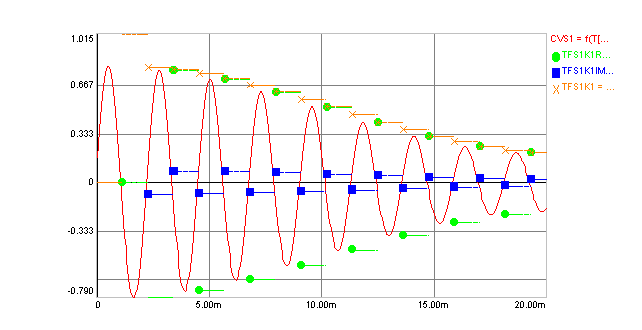
Fig. 1: Dominante Schwingung eines Vokals (rot), Bildung des Merkmalsvektors bestehend aus Real- (grün), Imaginärteil (blau) und Amplitude (gelb) nach jedem Ereignis d.h. nach jeder Halbschwingung
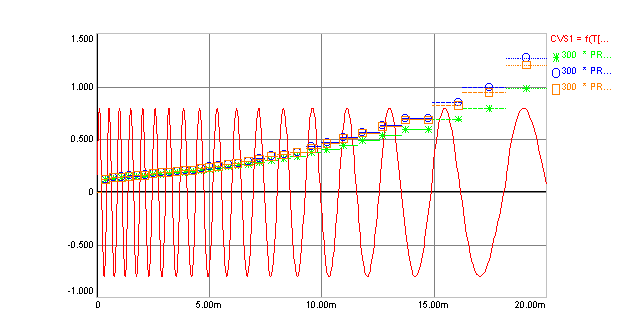
Fig. 2: Dominante Schwingung eines Konsonanten (rot), zeitliche Verteilung im Merkmalsvektor bestehend aus Periodendauer (grün), Vorhersage der Periodendauer erster Ordnung (blau) und Vorhersage der Periodendauer zweiter Ordnung (gelb)
Only entered events (after process of a half vibration) lead to standing up the features vector. Therefore the actual information content of a vowel can be condensed on a minimum. The features vector contains real and imaginary part for the dominant vibration and its amplitude. For harmonics of the signal can be won further features (not represented in fig. 1).
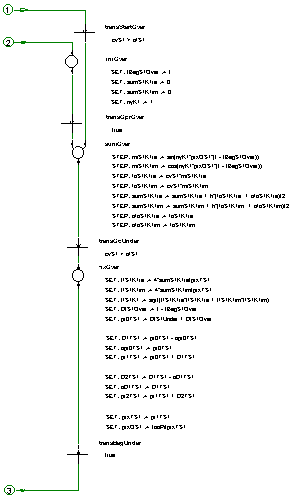
Fig. 3: Prototype of one event driven Time and Frequency Analysis, part from a state graph in accordance with UML version 1.0
To execute the event driven Frequency Analysis into fig. 1 online, in this the period duration of the dominant vibration must be ahead known. How it turns out, well it becomes the period duration "to predict", pointed in the second example: The above mentioned flexibility describes the short-term resonance of the signal source. Fig. 2 shows the dominant vibration of a signal with constant intensity however a variable (relieving) flexibility. They got borrowed the variety of the consonants of the human language. Thank for very briefly measure and analysis time an actual features vector with the measured period duration is immediately ready after the process of the dominant half vibration. It turns out, short-term frequency parts into consonants information technical to spread and his features vector driven in not equidistant steps by the event control to put. Further features in this vector are predicted periods duration of the first and second order, which are won from the first and second derivation of the period duration after the time. The predicted period duration of the nth order are used for even counting base points for an online FFT of the same Signal.
For the design of procedures, facilities and methods of the event driven Time and Frequency Analysis is recommended a prototype. Fig. 3 shows a part from the prototype for the extraction of the features vectors, which one into the fig. 1 and 2 was used. He was note down as state graph complies with the standard Unified Modeling Language version 1.0 [UML 97]: The transitions transStartOver and transGoUnder supervise the signal cvS1 to be analyzed. In the state iniOver the measuring in the upper half vibration is prepared, in the states sumOver executed and in fixOver completed. As mirror functions for the Fourier Transform pretended a Sinus function for miS1K1re and a Cosinus function for miS1K1im. Here will also provide every other explicitly portrayable function of the JTFA [Qian 96] or also Wavelets [Daube 92]. When required, the dimension (is here only complex) of the channel K1 will refines for Wavelets. In the state iniOver an ordinal number for the channel nyK1 = ny can provide. For the allocation of further ordinal numbers nyK2, nyK3, ... , nyKm must be established still corresponding further channels K2, K3, ... , Km (not represented in Fig. 3). It is remarkable, that by the introduced concept the number of the channel in the practical application remains limited on 8 to 32. What to be analyzed in every channel (mirror function, ordinal number, equation with the method etc.) is newly assigning from event to event.
The charges to the implementation of event driven procedures into hard and software solutions are not insignificant. For this reason the integral system consideration is supported in special way of the author. In the formulation of this task are selected into dependence of the signal to be analyzed (1) suitable procedures for the period duration measuring. The (2) gradually generation of the events will then defined. Then the (3) number of the states, which the event driven Time and Frequency Analysis arises, can take. In conclusion the (4) states get agree the transformation rules and finally the (5) in and output data formats will assigned.
The event driven Time and Frequency Analysis (edT&FA) are not only used for discontinuous signals. Among other things they is usually excellently for the analysis of natural signals, which is characterized by a dominant vibration, like also the human language. Based of the modern Microtechnologie arise various applications for the structure examinations into nature, technique and economy. The event driven Time and Frequency Analysis is further preferably suitable for the Neuronal processing, as it is used into the Diagnosis of machines, vehicle and aggregates as well as for the automatic speech recognition (ASR). The development, already above recommended, of one prototype in a standardized language of design will to perform the following steps: First the suitability of the prototypes, proved with help of test vectors (mathematically generated signals), can established. After this is carried out with help of the ready prototype the machine generation of the layout for a hardware solution or the automatic generation of the program code for a software solution. Also in this and all further design phases the prototype entitled at the disposal for verifying design, measure and analysis results.
Literature
[Reisig 82] Wolfgang Reisig: Petrinetze - eine Einführung. Springer-Verlag Heidelberg 1982
[Daube 92] Daubechies, I.: Ten Lectures on Wavelets. Society for Industrial and Applied Mathematic, Philadelphia, PA (1992)
[Jacob 95] Christian Jacob: Verfahren zur Periodendauer- und Wellenlängenmessung dominanter Schwingungen und Wellen sowie zur Spektralanalyse von Schwingungen und Wellen, Offenlegungsschrift DE 195 20 836 vom 31.05.1995
[Qian 96] Qian, S.; Chen. D: Joint Time-Frequenz Analysis, Methods and Applications. Prentic Hall. 1996
[UML 97] Unified Modeling Language (UML) Version 1.0 vom 13.01.1997